Disparities in the post-disaster recovery process
When disasters strike, the recovery process is not uniform across the population: some communities recover quickly, while others are left behind. These disparities are often driven by economic factors, such as community wealth, and, perhaps surprisingly, by demographic factors such as race and ethnicity. In the case of wildfires where harm is caused by smoke, the key driver of disparate outcomes is education level: studies show that more educated individuals spend more time indoors at home, an effect not seen based on income, suggesting it stems from awareness rather than ability or access. Studies have also shown that wealthier individuals are more likely to rebuild homes damaged by extreme weather events, while individuals from certain racial groups are more likely to evacuate as needed. Over the past several years, growing availability of high fidelity individual mobility data and other sources, such as Google Street View for assessing building damage and recovery, has enabled substantial work evaluating these disparities along several axes.
Social Capital and its relevance in post-disaster recovery
Social capital is broadly defined as the resources embedded in social ties. It can be categorized into bonding, bridging, and linking, which capture within group ties, ties between disparate groups, and a community's ties and connections to organizations and governmental institutions, respectively. Resilient recovery from disasters is enabled in part by coordination among people and mobilization of resources that are intangible and often stored in social ties. While linking social capital may be relevant to post disaster recovery, it is often hard to measure. Bridging social capital, on the other hand, enables access to critical information and resources beyond one's immediate social circle, which is especially valuable during times of need, such as after disasters. One way to measure bridging social capital is through cross-SES (Socio-Economic Status) ties, using online social media data that is now available at scale.
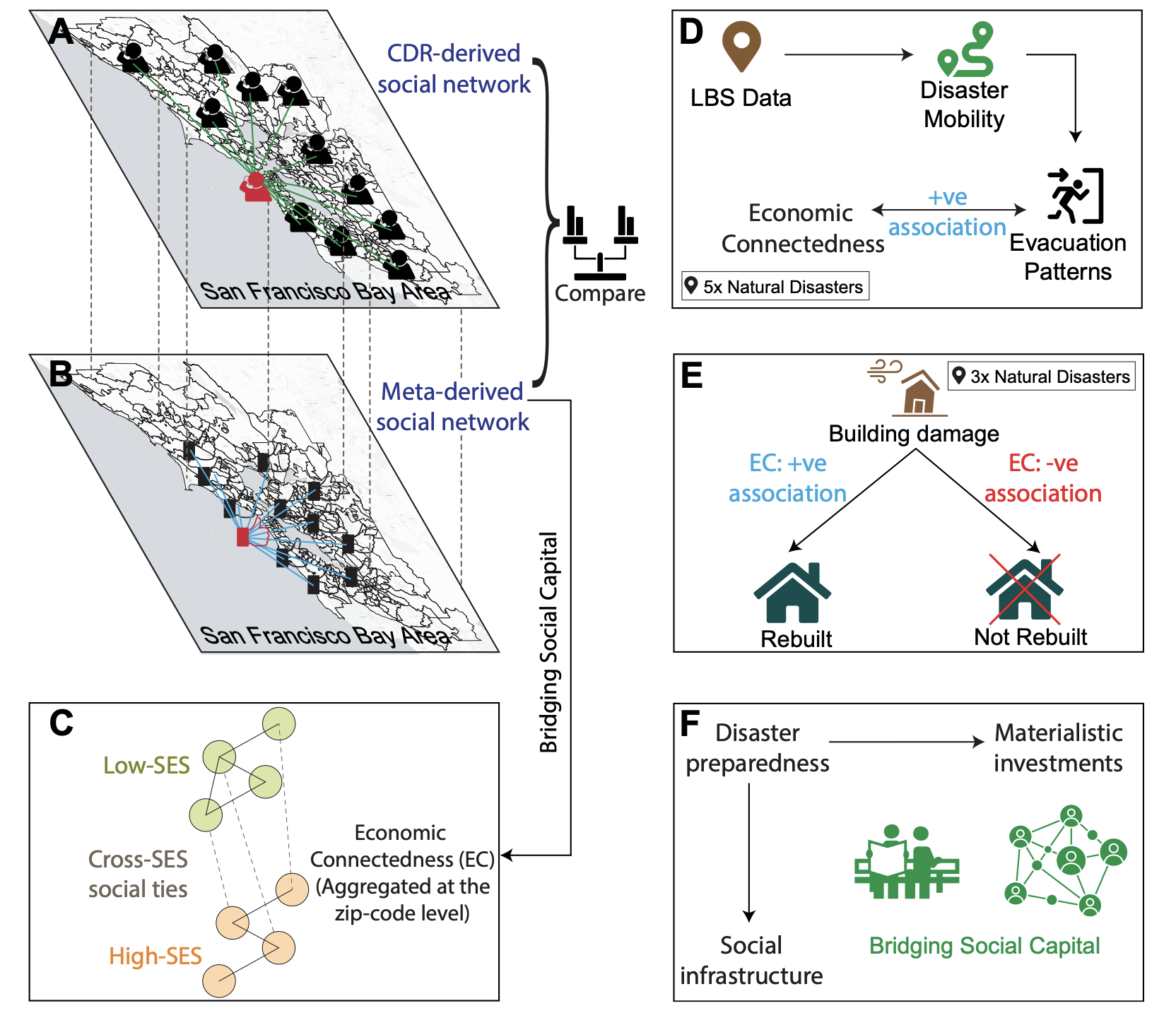
Bridging social capital as urban infrastructure.
Economic Connectedness attenuates income based disparities
We leverage Economic Connectedness, a measure of bridging social capital that quantifies the share of high income individuals among the social ties of low income individuals. This metric is available through the Social Capital Atlas, developed using data from online social media, namely Facebook. For five different extreme weather events in the US, we find that the income residualized measure of EC at the zip code level is associated with a higher evacuation rate, a higher likelihood of rebuilding, and a lower likelihood of abandonment of damaged homes post disaster. This finding holds for individuals irrespective of their own income group, reflecting that social ties to higher income people are associated with more desirable post disaster recovery outcomes, seen across all five extreme weather events.
What comes next?
We propose these methods of analysis, and future work can build on more extensive, individual level data to uncover the underlying causal mechanisms at play. Our findings carry policy implications for disaster preparedness: the spatial distribution of the EC metric could complement existing risk stratification frameworks, and could also inform investment in social infrastructure, such as parks and community spaces, particularly in neighborhoods where cross class ties are systematically sparse.